
01Distributed movement
Autonomous logistics
Assessment and integration planning for unmanned systems supporting distributed logistics operations.

Mission technology integration
Research, assessment, and integration support for autonomous systems and emerging technologies that strengthen logistics, operations, and mission support.
Conceptual visualization

Research prototype · In development
Rehearse the mission. See the whole operation.
A mission rehearsal console exploring how operators can plan and monitor simulated drone operations in one place. It brings the site, virtual fleet, coverage, and mission progress into a shared operational view.
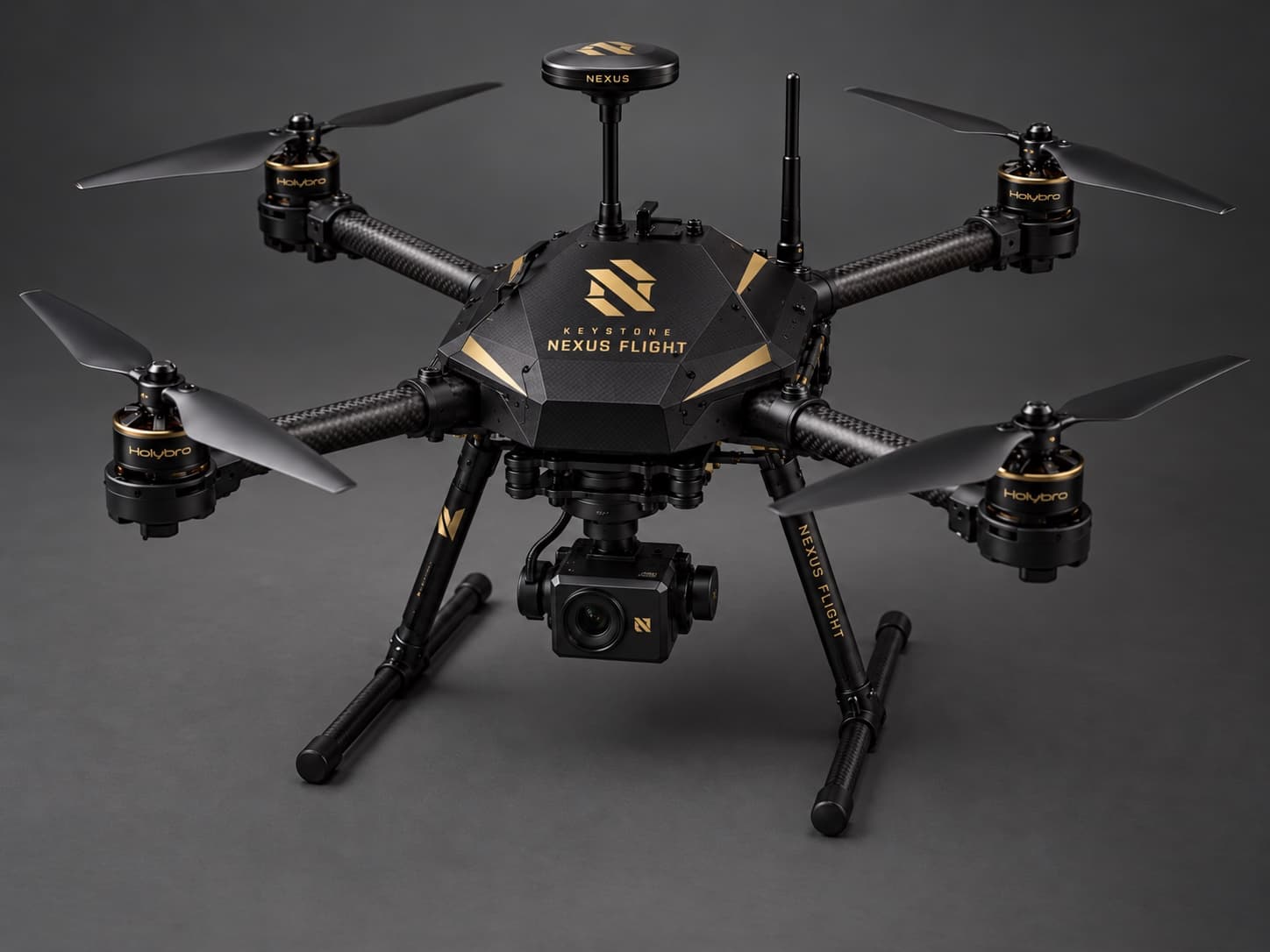
Drone prototype concept
Proposed Nexus Flight hardware design, shown as a concept illustration. Hardware integration remains in development.
The video below demonstrates the software simulation.
3D site visualization, virtual fleet monitoring, coverage overlays, and simulated mission progress.
Continued evaluation of operator workflows and staged hardware integration. Real-world autonomous flight is not demonstrated here.
01 / Capability matrix
We frame the need, evaluate candidates, and connect technical potential to a credible mission-support path.
Swipe the capability matrix
Assessment and integration planning for unmanned systems supporting distributed logistics operations.
Interface, workflow, and adoption support for aerial, ground, and robotic systems in operational environments.
Technical evaluation of AI-enabled decision support, automation, and operational workflow opportunities.
Exploration of adaptable platforms and payload concepts for logistics and mission-support requirements.
02 / Integration architecture
Operational value appears only when technology, interfaces, decision support, and transition controls work as one system.
Aerial, ground, autonomous, and modular robotic systems.
Payloads, data, controls, workflows, and operational handoffs.
AI-enabled analysis, automation opportunities, and operator visibility.
Testing, risk, adoption, training, and operational transition planning.
03 / Engagement path
Each phase narrows uncertainty before the next commitment is made. Scope and success measures are set for every engagement.
Translate operational needs into constraints, requirements, and evaluation criteria.
Need and evaluation criteria alignedAssess candidate technologies, interfaces, maturity, and mission fit.
Maturity, interfaces, and mission fit characterizedPlan staged prototyping, testing, adoption, and operational transition.
Staged test and transition path definedDesigned outcomes
Applicable NAICS
04 / Engage
We'll help frame the technical question, expose the integration risks, and define a credible path forward.